
Butterfly and Bird Watching, Butterfly Photo Exhibition & Talk Program
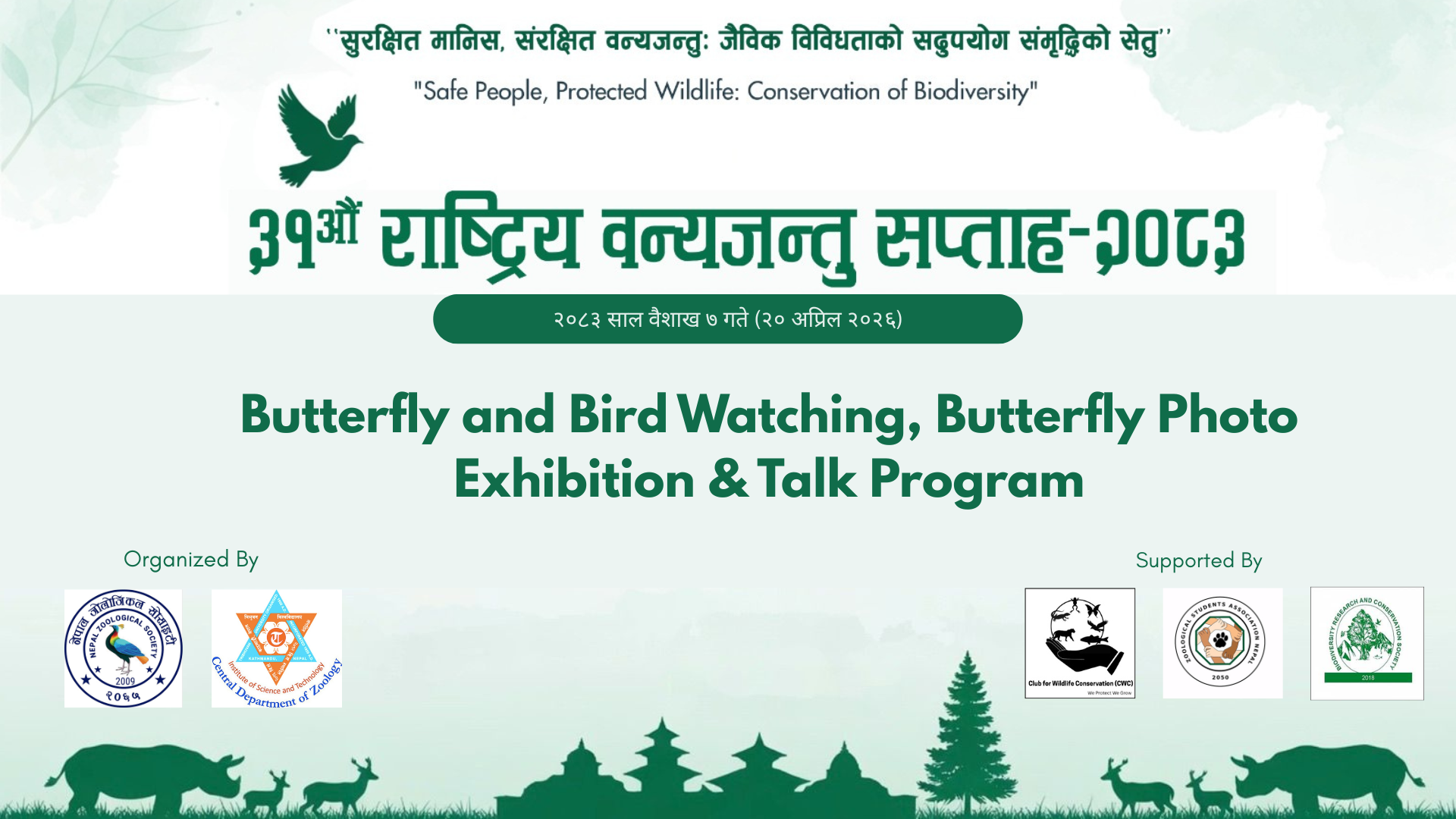

नेपाल जोलोजिकल सोसाइटी, गण्डकी प्रदेशको सहभागितामा पृथ्वीनारायण क्याम्पसको प्राणीशास्त्र विभाग र प्राणीशास्त्र समाज पोखरा नेपाल सँगको सहकार्यमा आयोजित २९ औ राष्ट्रिय वन्यजन्तु सप्ताह २०८१ (बैशाख १ गतेदेखि ७ गते सम्म) “वन्यजन्तुको संरक्षण: पर्यापर्यटन र आय आर्जन” भन्ने मुल नाराका साथ तीन दिवसिय बिभिन्न कार्यक्रम गर्दै भब्यरुपमा मनाउने काम बैशाख ७...

Globally, biodiversity is declining due to habitat loss and degradation, over-exploitation, climate change, invasive species, pollution, and infrastructure development. These threats affect the populations of large waterbird species, such as Sarus crane (Grus antigone), which inhabits agricultural–wetland ecosystems. Despite the burgeoning built-up areas and diminishing agricultural and wetland spaces, scant...

Co-occurrence and spatial and temporal overlap of sympatric jungle and leopard cats are influenced by habitat preferences, and interspecific competition. Understanding these factors influence is crucial for developing effective conservation strategies. We conducted a camera survey in Parsa‒Koshi Complex (PKC), Nepal during December 2022–March 2023 to investigate factors influencing occupancy...

The Chinese pangolin (Manis pentadactyla) confronts challenges from illegal hunting, trading, and habitat degradation. Therefore, it is imperative to establish and implement effective conservation strategies at both local and regional levels. However, there is limited information, particularly within the Kathmandu Valley of Nepal, underscoring the significance of local-level habitat characterization...

The knowledge and attitudes of local communities are essential for understanding the distribution, ecology, and pertinent threats to bird species, particularly those existing beyond protected areas. Despite the reliance of large waterbirds like storks on human-dominated landscapes, research in this domain is limited across its range. To address this knowledge...

Understanding factors associated with coexistence of human and wildlife in human-dominated landscapes is crucial for effective species conservation. Among the wildlife species, the sloth bears Melursus ursinus are found both inside and outside the protected areas of Nepal, and with increasing cases of human and bear conflicts in both areas. This highlights...
The Himalayan goral (Naemorhedus goral) is facing threats, such as habitat degradation and human disturbances, which are increasing. To aid their conservation, it is crucial to understand the anthropogenic and ecological factors that influence Himalayan goral occurrence. We conducted a study in Dhorpatan Hunting Reserve, Nepal using remote cameras to...
Water hyacinth (Pontederia crassipes) invasion is a growing global issue which poses a threat to aquatic life. As in the global context, the water hyacinth invasion is increasing rapidly in the lakes of Pokhara valley which is listed in Ramsar sites. Its effect on aquatic life is little known. This study...

Understanding wildlife behavior, including accurate identification, processing, and interpretation of activities or cues, is important to behavioral biology and corresponding conservation strategies. We characterized the breeding activities of the critically endangered White-rumped Vulture Gyps bengalensis following a sequential pattern from courtship to fledging. We recorded 4,160 visual observations of 20 behaviors of eight...

Among the several anthropogenic factors, power lines are increasingly regarded as one of the most significant hazards to bird species, primarily owing to collisions and electrocutions. Nepal has comparatively fewer studies on the impact of power line collisions and electrocution on birds compared with developed nations. From November 2021 to...
The red panda (Ailurus fulgens) population is decreasing, with less than 10,000 individuals in the wild because of habitat destruction, fragmentation, and illegal hunting. Captive breeding has become an increasingly crucial strategy for conserving endangered species, but efforts to generate self-sustaining populations have failed despite ample resources being allocated. Animals...